

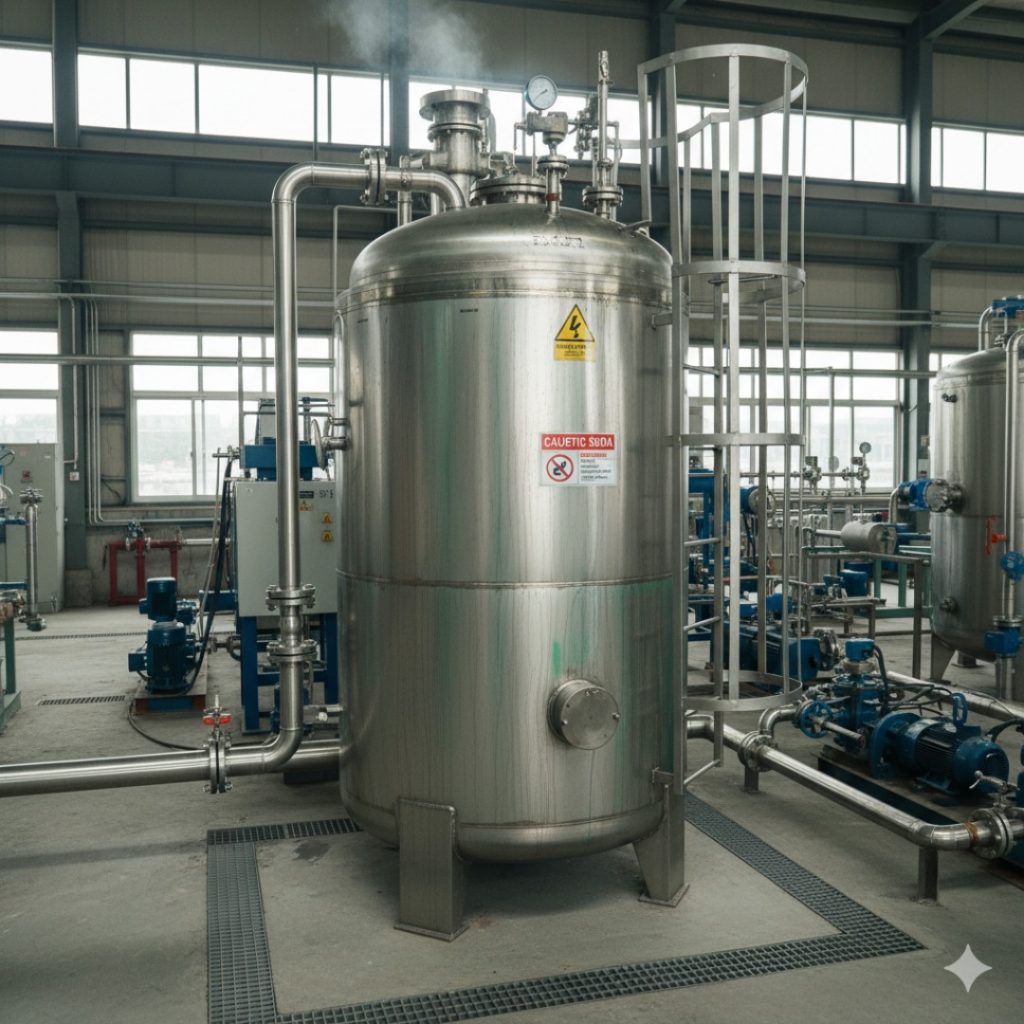
Caustic soda is one of the most aggressive components of the chemical industry. This substance, especially known as sodium hydroxide (NaOH), is widely used in many areas such as cleaning products, the paper industry, and water treatment. However, storing caustic substances safely and for a long time requires serious engineering. This is where stainless steel caustic tanks come into play.
What is a Stainless Steel Caustic Tank?
A stainless steel caustic tank is an industrial tank specially designed to safely store corrosive chemicals, usually made of AISI 304 or 316 grade stainless steel. These tanks offer both chemical resistance and long life. Unlike standard tanks, they feature a thicker wall structure, high acid-base resistance, and specially sealed equipment.
Usage Areas
Chemical Industry
Caustic soda is frequently used as a solvent and base in chemical production. Stainless steel tanks safely store these substances.
Food Industry
Caustic soda, used for cleaning in food production, must be stored in tanks with high hygiene standards.
Cleaning Products Production
Caustic soda, which is the raw material of household and industrial cleaning products, poses a risk if not stored under appropriate conditions.
Treatment Facilities
Caustic soda is used in wastewater treatment for pH balancing; stainless steel tanks offer safe solutions in these processes.
Why is Stainless Steel Material Preferred?
Corrosion Resistance
Stainless steel is highly resistant to aggressive substances such as caustic soda.
Long Life and Hygiene
Thanks to its non-bacterial structure, it is hygienic and can be used for a long time.
Easy Cleaning and Maintenance
Thanks to its smooth-surfaced internal structure, it is easy to clean. It is also compatible with CIP systems.
Technical Specifications of Stainless Steel Caustic Tanks
AISI 304 / 316 Quality Difference
304 quality is sufficient for general chemicals; 316 quality is ideal for more concentrated and dangerous chemicals.
Jacketed and Heated Structures
Jacketed models are preferred to provide heating or cooling inside the tank.
Mixer Systems
Homogeneity is ensured with mixer systems for high-density liquids.
Level Indicator and Safety Systems
The tank content is safely controlled with level sensors and pressure safety valves.
Caustic Tanks Produced with Asinoks Difference
Custom Production and Engineering
Asinoks produces tanks in special sizes and technical features for every need.
Custom Size and Equipment on Demand
Project planning is done specifically for your business’s capacity and needs.
Quality Control Processes
Each product undergoes leakage and durability tests before shipment.
What Should Be Considered When Choosing a Stainless Steel Caustic Tank?
Suitability for Raw Material
The steel quality should be determined according to the caustic substance to be stored.
Capacity Need
The correct volume should be selected according to the business volume and consumption amount.
Operating Environment Conditions
The temperature, humidity, and environmental risks of the area where the tank will be used should be taken into consideration.
Certification and Standards
Quality should be ensured with documents such as CE and ISO.
Compliance with CIP Cleaning System
Tanks compatible with the CIP (Clean In Place) system provide internal washing without stopping production. This means both hygiene and time savings.
Storage and Safety Measures
Acid and Base Safety
Special sealing and ventilation systems should be in place for the hazards caused by caustic substances.
Explosion, Leakage and Overflow Risks
These risks are minimized with sensor-supported control systems.
Energy Efficiency and Environmental Impacts
Contribution of Insulated Structures
Reduces energy costs by preventing heat loss.
Sustainability with Recycling
Stainless steel is completely recyclable and environmentally friendly.
Cost and Return on Investment
Initial Investment and Long-Term Gain
Although the initial cost seems high, the amortization period is short thanks to its long life.
Maintenance and Service Advantages
Thanks to Asinoks’s technical service network, it provides the advantage of minimum failures and rapid intervention.
Conclusion
Stainless steel caustic tanks offer indispensable solutions for the safe and hygienic storage of chemical substances. As Asinoks, we produce safe and durable caustic tanks that are specific to the needs of your business with our experience in the sector. Asinoks is always with you with quality production, technical support, and engineering solutions!
Frequently Asked Questions (FAQ)
- How long can a stainless steel caustic tank be used?
It can be used for up to 20 years with proper maintenance. - What is the advantage of tanks suitable for CIP systems?
It provides hygiene without stopping production and saves labor. - What is the difference between 304 and 316 grade stainless steel?
316 quality is more resistant to more aggressive chemicals. - Can the tanks be customized?
Yes, Asinoks offers custom sizes and technical equipment for every need. - How is tank maintenance done?
It is easily provided with periodic cleaning, seal control, and level sensor tests.