

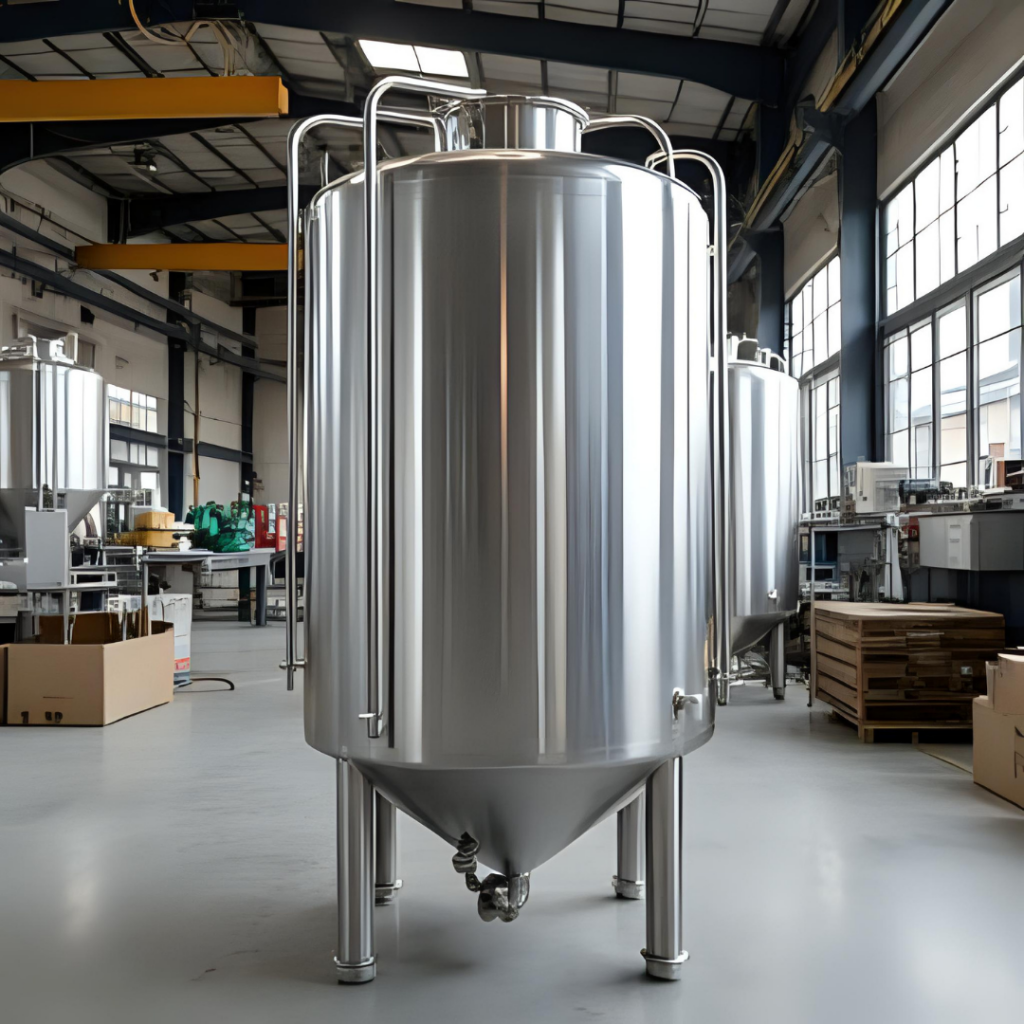
What is a Stainless Steel Acid Tank?
General Definition and Purpose
Stainless steel acid tanks are industrial equipment that ensures the safe storage of aggressive chemicals and acids. These tanks, made of special stainless steel that offers high corrosion resistance, are preferred in many industries due to their long-lasting and durable structure.
Differences from Other Tanks
Compared to plastic, carbon steel, or galvanized tanks, stainless steel tanks are far superior in terms of both temperature and chemical resistance. Additionally, the risk of leakage into the environment is minimized.
Technical Specifications
Types of Materials Used (304, 316, 316L)
316L grade stainless steel is most commonly preferred in acid tanks. This alloy provides chemical resistance thanks to its molybdenum content and does not deteriorate in contact with acids. 304 grade is suitable for less aggressive liquids.
Jacketed Structures and Insulation
Thanks to double-walled tanks, the temperature of the liquid inside can be kept under control. At the same time, heat exchange with the external environment is minimized, ensuring that the chemical remains at a constant temperature.
Resistance to Pressure and Chemicals
Stainless steel acid tanks are resistant to both internal pressure and external environmental factors. It continues to operate without being affected by vibration, impact, and sudden temperature changes.
Usage Areas
Chemical Industry
Stainless steel acid tanks are indispensable in chemical plants where aggressive substances are processed. It is used for storing, transferring, and dosing acids.
Food and Pharmaceutical Industry
It offers ideal solutions for the hygienic storage of cleaning chemicals and additives.
Treatment Systems and Waste Management
Neutralization chemicals and acids used in treatment plants are safely stored in stainless steel tanks.
Energy and Petrochemical Plants
Thanks to their high heat and pressure-resistant structures, they undertake critical tasks in energy production and refineries.
Durable Design Details
Interior Coating Types
The inner surface of the tank can be reinforced with additional protective coatings depending on the type of acid. These coatings extend the life of the material and eliminate the risk of reaction.
Sealing Systems
The gaskets, flanges, and sealing components used in the tanks prevent chemical leakage. These systems also increase safety.
Valve, Sensor, and Cover Technologies
Tanks can be monitored both manually and automatically with pressure relief valves, level indicators, and automatic control systems.
Static Load and Explosion Prevention
Grounding systems are integrated to prevent the build-up of electrostatic charge. Special safety valves are used in environments with a risk of explosion.
Correct Tank Selection
Properties of the Acid to be Stored
Each acid has different physical and chemical properties. The appropriate steel grade and coating should be preferred depending on the type of acid to be stored.
Tank Capacity and Sizing
Production is possible in different volumes from 500 liters to 50,000 liters, depending on the need. Dimensions should be made by considering the physical space and liquid flow rate.
Appropriate Load Carrying Calculations
The contact of the tank with the ground and its load-bearing capacity are determined by static engineering calculations. In this way, possible collapses are prevented.
Asinoks Quality and Difference
Domestic Production and Documents
Asinoks is a company that carries out all its production in Türkiye and has quality certificates such as ISO, CE, and TSE. Quality control processes are applied at every stage.
Project-Specific Engineering Support
Special solutions for non-standard needs are developed by Asinoks’ engineering staff. Support is provided at every stage from technical drawing to assembly.
Long Life and Efficiency
Thanks to the quality of the materials used and the production technique, the tanks serve flawlessly for years. This significantly reduces maintenance costs.
Advantages of Stainless Steel Acid Tank
Corrosion Resistance
Thanks to its structure resistant to the most difficult chemicals, it eliminates risks such as leakage and perforation.
Ease of Cleaning and Hygiene
Thanks to its smooth inner surface, cleaning operations are carried out easily. This provides a great advantage in sectors such as food and medicine.
Economical and Sustainable Solution
Although the initial investment cost seems high, it is an economically preferable choice in total with its long life and low maintenance cost.
Assembly and Preparation for Use
Shipping and Installation
The transport of stainless steel acid tanks must be done carefully and with special equipment. Asinoks ensures the safe transport of the tanks after production and carries out the installation with expert teams at the installation site. In this process, ground control, fixing, and the accuracy of connection lines are examined in detail.
Test Processes and Initial Start-up
After the installation is completed, all systems of the tank are tested. Steps such as leak-proofness, pressure resistance, sensor operation, and valve control are meticulously carried out before commissioning. The tank, whose testing process is successfully completed, is made completely ready for use.
Maintenance and Cleaning Guide
Interior Surface Cleaning
One of the biggest advantages of stainless steel is that it is easy to clean. Periodic cleaning should be done to prevent the accumulation of acid residues. Appropriate chemicals that will not damage the surface should be preferred for cleaning.
Periodic Inspections
The inner and outer surfaces of the tank should be checked regularly. Welding points, covers, sensors, and connection points should be checked for any signs of leakage or wear.
Review of Safety Systems
Pressure relief valves, level sensors, and automatic control systems should be tested at certain intervals. The healthy operation of these systems directly affects the safety of the tank.
International Compliance and Standards
CE, ISO, TSE Certificates
All stainless steel acid tanks manufactured by Asinoks carry the CE mark and are manufactured in accordance with the ISO 9001 quality management system. It is also guaranteed by TSE documents.
Compliance with European and American Norms
Production is carried out in accordance with international norms such as DIN, ASTM, and ASME, and engineering studies are carried out according to these standards, especially in export projects.
Why Asinoks?
Reliable Production Process
Asinoks manufactures stainless steel tanks with high-quality standards with its years of experience in production. Every stage, from material supply to welding processes, is kept under control.
Sectoral Expertise
Having provided solutions to hundreds of projects in different sectors enables Asinoks to analyze needs correctly. It stands out with its technical knowledge of acid tanks.
Customer Satisfaction and Technical Support
After-sales support is as important as the product. Asinoks attaches importance to customer satisfaction not only with sales but also with maintenance, spare parts, and technical consultancy services.
Result
Stainless steel acid tanks offer safe, hygienic, and long-lasting solutions in the field of chemical storage. Preparing these tanks with the right material, with the appropriate engineering approach, and with quality production directly affects the safety of businesses.
As Asinoks, we offer special solutions for each project and manufacture without compromising on quality and safety. Together with our expert engineering staff, we develop designs specific to your stainless steel acid tank needs and complete the production completely.
If you are also looking for a safe and long-lasting acid tank for your business, you are in the right place. To get detailed information, you can visit www.asinoks.com or contact us.
Frequently Asked Questions (FAQ)
- Which acids can stainless steel acid tanks be used with?
316L grade stainless steel; It can be used with many aggressive chemicals such as sulfuric acid, nitric acid, and phosphoric acid. However, special analysis should be done for each acid. - Can stainless steel tanks be used outdoors?
Yes, it can also be used outdoors. However, insulation and UV protection can be preferred to provide protection against external factors. - Is an internal coating of the tank necessary?
It is decided according to the type of chemical to be stored. While additional internal coating may not be required for some acids, PTFE or similar coatings are recommended for others. - Which sectors does Asinoks serve?
It offers special stainless steel solutions for many sectors such as chemistry, medicine, food, energy, petrochemistry, and water treatment. - How long does it take to deliver stainless steel acid tanks?
Although it varies depending on the size and characteristics of the project, standard productions are generally completed within 2 to 4 weeks.