

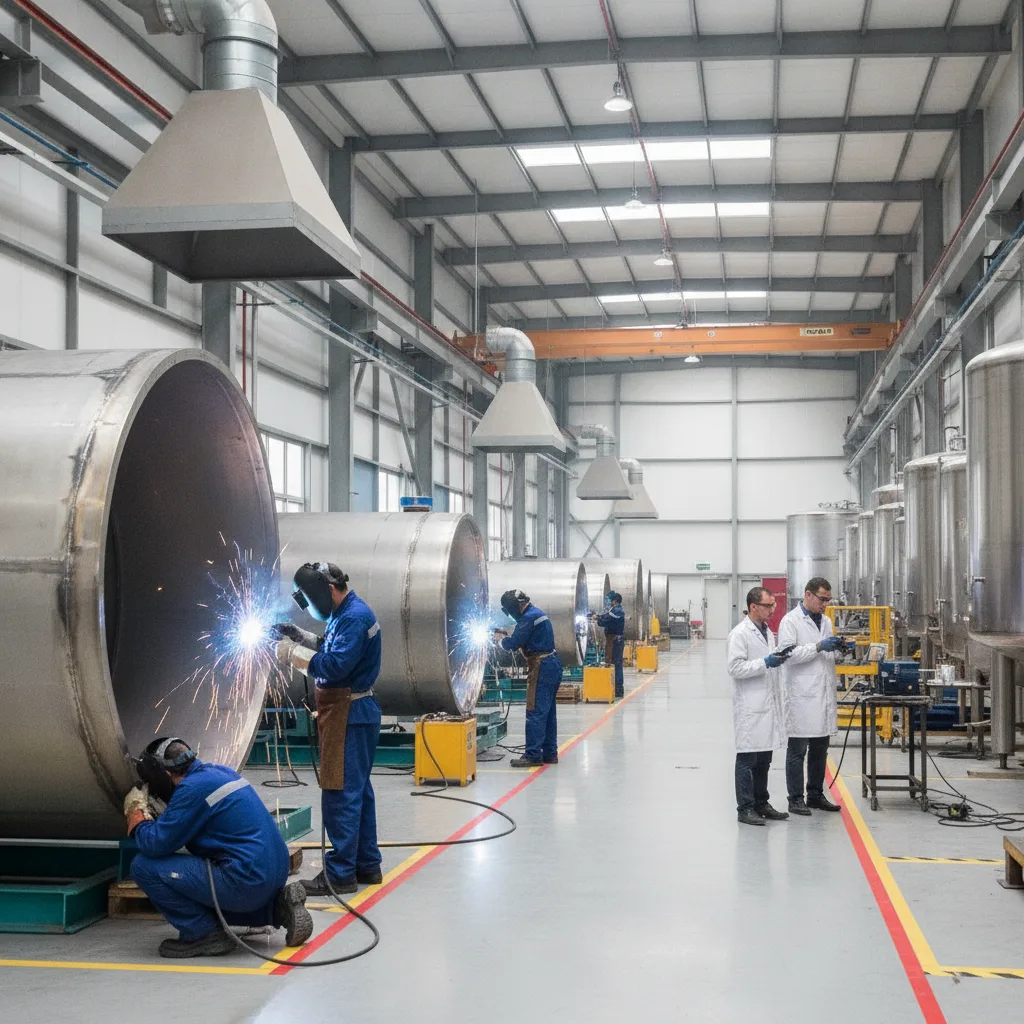
Industrial Stainless Steel Tank Manufacturing Process: A Comprehensive Look from Design to Delivery
Stainless steel tanks, indispensable elements of industrial facilities, play a critical role in liquid and gas storage, mixing, and reaction processes. Especially in sectors such as food, chemical, pharmaceutical, and petrochemical, hygiene, durability, and safety standards must be maintained at the highest level. Therefore, an industrial stainless steel tank manufacturing process consists of a complex series of steps requiring engineering expertise, precise craftsmanship, and comprehensive quality control. As Asinoks Metal, we aim for excellence at every stage of this process, offering long-lasting and reliable solutions to our customers. The industrial stainless steel tank manufacturing process includes detailed project planning, correct material selection, precise welding techniques, comprehensive quality control, and compliance with international standards.
Critical Importance and Application Areas of Industrial Stainless Steel Tanks
Stainless steel tanks are preferred in many industrial areas due to their corrosion resistance, hygienic structure, and high-temperature durability. They are vital, especially in the food sector for storing products like milk, fruit juice, and oil; in the chemical sector for preserving acids, bases, and other chemicals; and in the pharmaceutical sector for ensuring sterile conditions. These tanks can be specially designed not only for storage but also for processes such as mixing, heating/cooling, and reaction. Thanks to this versatility, the industrial stainless steel tank is one of the cornerstones of modern production.
An Engineering Marvel: Key Steps in Stainless Steel Tank Design
Every successful stainless steel tank production stage begins with a detailed design and project planning process. Customer needs, properties of the material to be stored, operating temperature, pressure, and volume are meticulously analyzed. At this stage, the industrial stainless steel tank project planning stages are carried out using CAD (Computer-Aided Design) and 3D modeling software. The design includes all details such as tank dimensions, wall thickness, connection points, agitator systems, and heating/cooling jackets. This engineering marvel directly affects the tank’s performance, safety, and lifespan.
The Beginning of Quality: Correct Stainless Steel Material Selection and Certification
The quality of a stainless steel tank is directly proportional to the quality of the material used. Stainless steel tank material selection and properties are determined according to the environment in which the tank will be used and the substance to be stored. For example, in the food and pharmaceutical sectors, low-carbon, high-corrosion-resistant stainless steels such as 304L or 316L are generally preferred. The material’s chemical composition, mechanical properties, and surface quality must be documented with certificates compliant with international standards (e.g., ASTM, EN). This is the first step towards ensuring the tank is long-lasting and safe.
Precise Manufacturing: Step-by-Step Production Process from Welding Techniques to Assembly
After the design and material selection are completed, the stainless steel tank production stages move into the manufacturing process. This stage requires high precision and expertise.
- Material Cutting and Shaping: Stainless steel sheets are precisely cut using laser cutting, plasma cutting, or guillotine shears. Then, bending and rolling processes are applied to form cylindrical or conical shapes. Special bending techniques are used for prismatic tanks.
- Welding Techniques and Joining: Tank parts are joined by expert welders. Among industrial stainless steel tank welding techniques, TIG (Tungsten Inert Gas) and MIG (Metal Inert Gas) welding methods stand out. Especially for hygienic applications, internal surface welds must be smooth and pore-free, and weld seams must be meticulously cleaned. This is a critical detail for hygienic stainless steel tank production steps.
- Surface Treatments and Passivation: After welding, surfaces are smoothed with processes such as mechanical polishing, pickling, or electro-polishing. These processes ensure the hygienic condition of the tank’s internal and external surfaces and increase corrosion resistance. Passivation re-establishes the stainless steel’s natural protective oxide layer, providing an extra barrier against corrosion.
Guarantee of Safety: Comprehensive Quality Control and Testing Processes in Stainless Steel Tanks
Industrial tank quality control processes applied at every stage of manufacturing guarantee the tank’s safety and performance. Weld seams are inspected using non-destructive testing (NDT) methods such as radiographic testing (RT), ultrasonic testing (UT), magnetic particle testing (MT), and liquid penetrant testing (PT). Additionally, the tank’s leak-tightness and pressure resistance are verified with hydrostatic pressure tests. Stainless steel tank testing and inspection methods confirm the tank’s compliance with specified standards and customer expectations. As Asinoks Metal, in accordance with our stainless steel tank manufacturers’ quality policy, we subject every product to the strictest inspections.
Sectoral Standards and Safety Protocols: Points to Consider in Production
The production of industrial stainless steel tanks is subject to many national and international standards and safety protocols. Certifications such as ASME (American Society of Mechanical Engineers), PED (Pressure Equipment Directive), CE mark, and ISO 9001 demonstrate that the tank’s design, manufacturing, and testing processes meet specific quality and safety requirements. Stainless steel tank production standards and stainless steel tank safety procedures are vital to ensure the tank operates safely and efficiently throughout its lifespan. Stainless steel tank certification requirements are mandatory, especially for pressure vessels and tanks storing hazardous materials. An industrial stainless steel tank manufacturing process is not just about shaping metal. This process is a comprehensive journey requiring engineering knowledge, technological competence, meticulous craftsmanship, and adherence to international standards. As Asinoks Metal, we design and produce each of our stainless steel tanks to meet the highest quality and safety expectations in the industry. You can contact us for reliable and long-lasting stainless steel tank solutions tailored to your needs.
Frequently Asked Questions (FAQ)
What are the main stages of the industrial stainless steel tank manufacturing process?
The industrial stainless steel tank manufacturing process consists of project planning and design, material selection, cutting and shaping, welding and joining, surface treatments, quality control and testing, and certification stages.
What quality control methods are used in stainless steel tank production?
Comprehensive quality control methods such as non-destructive testing (NDT) methods (radiographic, ultrasonic, magnetic particle, liquid penetrant tests) and hydrostatic pressure tests are applied in stainless steel tank production.
Are there special steps to consider in hygienic stainless steel tank production?
Yes, in hygienic stainless steel tank production, it is critically important that internal surface welds are smooth and pore-free, weld seams are meticulously cleaned, and surface treatments such as mechanical polishing and passivation are applied.